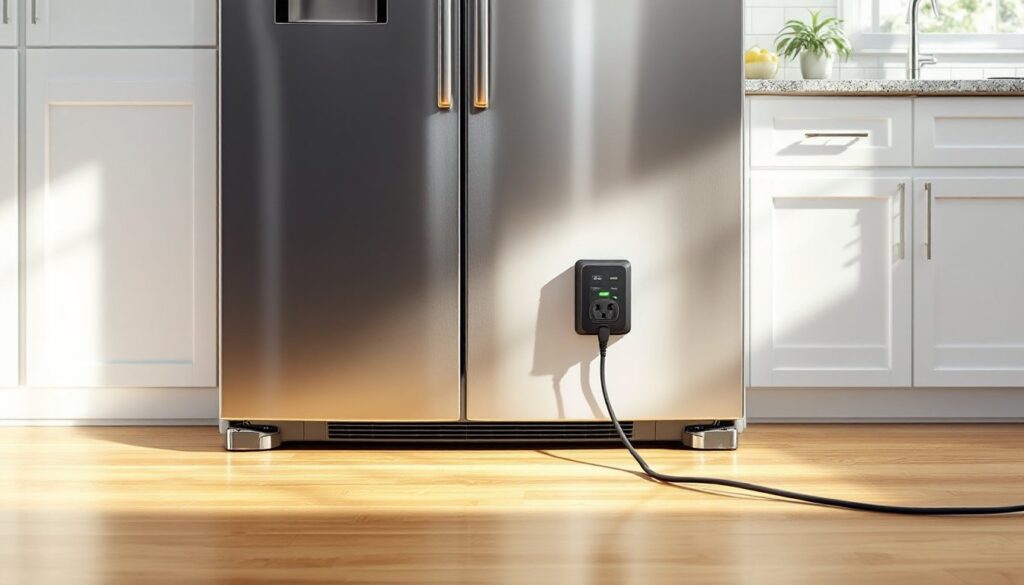

Modern refrigerators aren’t just boxes that keep milk cold. They’re sophisticated appliances packed with electronic controls, compressor circuits, and touchscreen interfaces worth $1,500 to $5,000 or more. A single voltage spike can fry the control board, damage the compressor, or corrupt the digital display, repairs that often cost $300 to $800 just in parts. Most homeowners don’t think twice about plugging a fridge straight into a wall outlet, but power surges happen more often than you’d expect: lightning strikes, utility grid switching, even your AC kicking on can send a damaging jolt through your home’s wiring. A quality surge protector offers inexpensive insurance against these invisible threats.
Table of Contents
ToggleKey Takeaways
- A surge protector for refrigerator is essential insurance against power surges that can damage expensive control boards, compressors, and electronic displays costing $300–$800+ to repair.
- Choose a surge protector rated for at least 15–20 amps continuous with 2,000+ joules capacity and 400V or lower clamping voltage to handle your fridge’s startup demands.
- Internal power surges from utility switching and appliance cycling are far more common than lightning strikes and cause gradual damage to sensitive refrigerator components over time.
- Always plug your surge protector directly into a wall outlet on a properly grounded, dedicated 15–20A circuit—never daisy-chain or use extension cords.
- Look for UL 1449 certification, indicator lights showing protection status, and thermal fusing as signs of quality; avoid power strips rated under 15 amps and units under $15.
- Replace your surge protector immediately after a major surge event or when indicator lights show depleted protection, and consider adding whole-house panel protection for comprehensive defense.
Why Refrigerators Need Surge Protection
Refrigerators operate 24/7, drawing continuous power for years without a break. That constant connection to your home’s electrical system means constant exposure to voltage fluctuations.
Unlike a lamp or toaster with simple on/off circuitry, modern fridges rely on sensitive electronic control boards that manage defrost cycles, temperature sensors, compressor speed (in variable-speed models), ice makers, and digital displays. These components operate on precise voltage tolerances, typically within 5-10% of the rated voltage. When a surge pushes voltage outside that range, even for a few milliseconds, it can degrade or destroy semiconductor components.
Power surges don’t always announce themselves with a lightning bolt. Internal surges are far more common: when high-draw appliances like HVAC systems, washing machines, or well pumps cycle on and off, they can create brief voltage spikes throughout your home’s circuits. Over time, these mini-surges cause cumulative damage that shortens component lifespan.
Refrigerators also draw significant starting current when the compressor kicks on, anywhere from 3 to 6 times the running amperage for a fraction of a second. If a surge hits during that startup phase, the compressor windings are especially vulnerable to damage. That’s why appliance manufacturers often void warranties if damage is attributed to power anomalies and no surge protection was in place.
Many homeowners assume their main electrical panel provides sufficient protection. Standard circuit breakers protect against overloads and short circuits, but they don’t suppress voltage spikes. That’s a different job entirely.
How Power Surges Damage Your Refrigerator
A power surge is a sudden increase in voltage that lasts anywhere from a few microseconds to several milliseconds. Normal household voltage in the US is 120V AC (with a tolerance range of about 114-126V). A surge can spike that to 500V, 1,000V, or higher depending on the source.
When excess voltage hits your fridge, the first casualty is usually the main control board. These printed circuit boards contain microprocessors, capacitors, and transistors rated for specific voltage thresholds. Overvoltage causes dielectric breakdown in capacitors (they literally burst or short internally) and burns out transistor junctions. Once the control board fails, your fridge won’t regulate temperature, run defrost cycles, or operate the ice maker.
The compressor is the heart of your refrigerator’s cooling system. It contains electromagnetic windings that can be damaged by voltage spikes, especially during startup when inductive loads are highest. Compressor failure is one of the most expensive repairs, $400 to $700 in parts and labor for most units. In many cases, it’s more economical to replace the entire fridge.
Other vulnerable components include:
- Temperature sensors and thermistors: These solid-state components fail when voltage exceeds their ratings, leading to inaccurate temperature control.
- LED displays and touchscreen interfaces: Sensitive electronics that can suffer pixel burnout or complete failure.
- Ice maker assemblies: Contains its own control circuitry that’s susceptible to surge damage.
- Defrost timers and heaters: Electromechanical or solid-state components that regulate defrost cycles.
Lightning strikes are the most dramatic surge source, but they account for less than 5% of surge events. According to testing by appliance safety experts, utility grid switching, transformer issues, and internal appliance cycling cause the vast majority of damaging surges. You won’t see sparks or smell smoke, just a fridge that stops cooling properly one day.
Choosing the Right Surge Protector for Your Fridge
Not all surge protectors are created equal, and most power strips aren’t suitable for refrigerators. Start with these baseline requirements:
Amperage rating: Refrigerators typically draw 6-8 amps during normal operation but can spike to 15-20 amps momentarily during compressor startup. Your surge protector must handle at least 15 amps continuous (look for a 15A or 20A rating). Most standard 6-outlet power strips are rated for only 10-13 amps and will trip or overheat under fridge loads.
Single-outlet design: Use a dedicated surge protector with one or two widely-spaced outlets. Avoid plugging other appliances into the same unit, your fridge needs a clean, dedicated circuit. The National Electrical Code (NEC) recommends dedicated 15A or 20A circuits for refrigerators.
UL 1449 certification: This Underwriters Laboratories standard rates surge protectors for safety and performance. Look for devices marked UL 1449 (4th edition is current as of 2026).
No master/switched outlets: Your fridge must receive constant power. Avoid surge protectors with motion-sensing shutoff, timers, or “master outlet” features that might interrupt power.
Joule Rating and Clamping Voltage
The joule rating measures how much surge energy a device can absorb before it fails. Think of it as a reservoir: higher capacity means more protection over time.
- Minimum for refrigerators: 1,000 joules. This handles typical surges from utility switching and internal appliance cycling.
- Recommended: 2,000-3,000 joules. Provides better protection against multiple events and extends the protector’s lifespan.
- Premium: 3,000+ joules. Worthwhile if you live in an area with frequent lightning or unstable grid power.
Joules are consumed with each surge event. A protector rated for 2,000 joules might absorb one large 2,000-joule hit or a hundred smaller 20-joule events before it’s depleted. Quality units include indicator lights that warn when protection is exhausted.
Clamping voltage (also called let-through voltage) is the threshold at which the protector begins suppressing excess voltage. Standard ratings are:
- 330V: Best protection, starts clamping closest to normal voltage.
- 400V: Good balance of protection and component longevity.
- 500V: Adequate for most appliances but allows more voltage through.
For a refrigerator, aim for 400V or lower. The tighter the clamping threshold, the less stress on your fridge’s electronics.
Response time matters too. Quality surge protectors react in less than one nanosecond. Cheaper units may take 5-10 nanoseconds, allowing a brief voltage spike through. Look for specifications listing response time under 1ns.
Installation Tips and Safety Considerations
Installing a surge protector for your refrigerator is straightforward, but placement and connection matter.
Plug directly into the wall outlet. Never daisy-chain surge protectors or plug them into extension cords. This creates resistance, heat buildup, and fire hazards. It also voids most product warranties and violates NEC guidelines.
Check outlet condition first. Use a receptacle tester (about $8 at any hardware store) to verify proper grounding. A surge protector can’t function correctly on an ungrounded or miswired outlet. If the tester shows a fault, call a licensed electrician before proceeding.
Position the protector accessibly. You’ll need to check indicator lights periodically and replace the unit when protection is depleted. Don’t bury it behind cabinets or appliances.
Verify circuit capacity. If your fridge is on a shared circuit with other high-draw appliances, you may experience nuisance tripping or insufficient surge protection. Refrigerators perform best on dedicated 15A or 20A circuits. Check your panel label or consult an electrician if you’re unsure.
Don’t use GFCI outlets for fridges unless required by code. Ground Fault Circuit Interrupter outlets are typically required within 6 feet of sinks (per NEC 210.8), but they can nuisance-trip and shut off your fridge. If you must use a GFCI circuit, test it monthly and make sure it’s readily accessible.
Consider whole-house surge protection as a supplement. Panel-mounted surge protectors (installed at your main breaker box by an electrician) provide first-line defense against external surges like lightning. They typically cost $150-$400 installed. Point-of-use protectors at the fridge outlet offer secondary protection. The two-tier approach gives the best protection, as explained in hands-on electrical guides.
Replace after major surge events. If you experience a nearby lightning strike or see the indicator light showing depleted protection, replace the unit immediately. Surge protectors sacrifice themselves to save your appliances, once the Metal Oxide Varistors (MOVs) inside are used up, you’re running unprotected.
Safety PPE: None required for simple plug-in installation. If you’re working inside the electrical panel for whole-house protection, that’s a job for a licensed electrician.
Top Surge Protector Features to Look For
Beyond the baseline specs, certain features separate adequate surge protectors from excellent ones.
Indicator lights: A must-have. Look for models with separate lights showing “protected” status and “grounded” status. Some premium units add an “overheat” warning light. These LEDs let you verify protection at a glance without testing equipment.
Thermal fusing: Quality protectors include internal thermal fuses that permanently disconnect the device if MOVs overheat or fail. This prevents fire hazards but means the unit needs replacement once the fuse blows.
EMI/RFI filtering: Electromagnetic Interference and Radio Frequency Interference filtering smooths out electrical noise that can degrade appliance performance. It won’t prevent catastrophic surge damage, but it reduces wear on sensitive electronics. Useful if you have fluorescent lighting, arc welders, or other noise-generating equipment nearby.
Warranty and connected equipment coverage: Many manufacturers offer connected equipment warranties ranging from $5,000 to $100,000. Read the fine print, most require proof of proper installation, grounded outlets, and timely registration. It’s secondary to choosing a quality product, but it adds peace of mind.
All-metal housing (optional): Plastic cases are standard and adequate. Metal-housed protectors offer slightly better EMI shielding and durability in workshop environments. Not essential for a kitchen fridge.
Flat or low-profile plug: Makes it easier to position your fridge flush against the wall. Right-angle plugs are especially handy for tight spaces.
No coax, Ethernet, or phone jacks: You don’t need these for a refrigerator. Simple single-outlet designs are more reliable and less expensive.
Home appliance reviews from sources like kitchen improvement sites often test surge protectors alongside appliances, offering real-world performance data rather than just spec sheets. Look for models that maintain stable voltage under load and don’t generate heat during normal use.
Avoid ultra-cheap units under $15, they typically use underrated MOVs, lack thermal fusing, and provide minimal joule protection. A quality fridge-rated surge protector runs $25-$60, a small investment compared to a $500 control board replacement.
Conclusion
Surge protection isn’t glamorous, but it’s one of the simplest ways to extend your refrigerator’s lifespan and avoid expensive repairs. Look for 2,000+ joules, 400V or lower clamping voltage, 15A+ capacity, and UL 1449 certification. Install it on a properly grounded outlet, check indicator lights every few months, and replace after major surge events. For $30 and five minutes of effort, you’re protecting a multi-thousand-dollar appliance that runs 24/7 for a decade or more. That’s a worthwhile trade.